Thursday, March 25, 2010

"A Tree Grows in Brooklyn"


"She was made up of all of these good and these bad things...She was the books she read in the library...Part of her life was made from the tree growing rankly in the yard. She was the bitter quarrels she had with her brother whom she loved dearly. She was Katie's secret, despairing weeping. She was the shame of her father staggering home drunk...She was all of these things and of something more...It was something that had been born into her and her only." --- A Tree Grows in Brooklyn, Ch. 7


"A Tree Grows in Brooklyn" is our book club selection for the month of April. I started reading it a little early because it's on the long side and I've been known not to finish a book in time for book club every once and awhile. As it turns out, finishing this book quickly was not a problem with this book. From the time I started reading, I was hooked.

The interesting thing about that is, "A Tree Grows in Brooklyn" isn't even a plot-driven book. Instead, the author relies on character development to engage her readers. I believe that it takes a great deal more talent to engage a readers through characters than through plot. Any Dan Brown or Steven King style serial novelist can hook readers with a thrilling plot that has an unexpected twist waiting around every corner. It's a lot more unusual to maintain that level of interest in a story that focuses on characters. But "A Tree Grows in Brooklyn"'s author, Betty Smith, does just that... and she does it extremely well.

The book is about a little girl named Francie Nolan, who is growing up at the turn of the century in the Williamsburg section of Brooklyn. She and her brother Neely, her mother Katie, and her father Johnny, are very poor and live in tenement housing. They are often cold and hungry in their home. Their mother works hard manual labor, while their father, a well-intentioned man who happens to be an alcoholic, is constantly in and out of work as a waiter. Despite their rough living conditions, the Nolans want better for their children than what they had themselves. Katie and Johnny, both first generation Americans, never had the option to attend high school, but they recognize the value and importance of education and want that for Francie and Neely.

The interesting thing about the book is that it moves both forwards and backwards in time. The book starts when Francie and Neely are about 9 and 10, and moves forward in time until they are young adults. However, the author also often shifts backwards in time, all the way back to when Katie and Johnny, the parents, were born. Through that, we learn about their own parents and upbringings, and are able to figure out why things are the way they are. Once again, it takes a really talented writer to make something like this interesting. I think what is most captivating about her characters, though, is that they are real. Often, characters in the novels that I read seem contrived. Although the male lead in Nicholas Sparks book may be extremely romantic, for instance, such a man is unlikely to exist in real life. In "A Tree Grows in Brooklyn," Smith dares to be honest... she lays all of her characters attributes out on the table... for better or worse. But they have flaws, just like the rest of us. It takes talent to prove to a reader that Johnny, an alcoholic "lazy bum" who can't support his family, can actually be a kind man with good intentions, but Smith does it successfully. Likewise, she shows that Katie, despite being a completely self-sacrificing mother, is no saint. Case in point, she often thinks to herself that she loves her son more than her daughter.

There is nothing remarkable about the plot of this book. Characters are born, characters die. Children grow up. Money is gained, money is lost. People move away. The world changes. Characters learn and grow. But this, in itself, is in fact remarkable, because this is real life. It was so refreshing to read a story that was so real. Despite the fact that it took place nearly 100 years ago, it was completely and entirely relatable to a modern reader such as myself. It goes to show that times may change, but human nature does not.

This book has definitely made it to my short list of favorite books of all time. If you haven't read it, you are missing out.

--- Emily

Monday, March 22, 2010

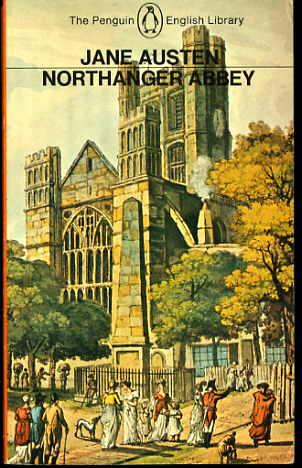
Northanger Abbey by Jane Austen


Jane Austen is one of those authors that I've been meaning to read for awhile. Toni and I were talking to Roberta, Toni's future mother-in-law, who has read many of Jane Austen's books and really enjoys them. She recommended "Northanger Abbey" as a good introduction to Jane Austen's writing style. So, the last time I went to the library, I decided to pick it up.

At first, I had a hard time getting in to the book. I've been reading a lot of contemporary writing lately, so it was hard to switch gears and adjust to her flowery, old-fashioned language. The first 10 pages or so really dragged on for me, but I forced myself to keep going. I'm really glad I did, because the book got better as I went on.

The book is about a young woman named Catherine Morland, who comes from a middle-class family with a lot of children. She gets the opportunity to travel to Bath with her neighbors, a childless couple. There, she meets a man named Henry Tilney who she is very interested in. But Catherine is very naive and modest and is not aware of her own beauty, nor is she aware of the fact that her interest him Henry is being reciprocated. Somewhat of a comedy of errors ensues as Catherine navigates the world of courtship and as she attempts to pick up on he social cues around her.

THe second half of the novel centers around Catherine's trip to Northanger abbey with the Tilney family (she is invited by Henry's sister, Eleanor). The tone of the novel takes a different turn in this half. Where the first half of the novel is lighthearted and frivolous, with the overall vibe of a love story, the second half takes on a more gothic turn. In the first half, it is mentioned that Catherine loves gothic novels, and reads them quite frequently. So when she enters the abbey, it seems that she expects to actually experience the content of one of these gothic novels. She anticipates (and hopes for) something exciting and scary to happen while she's there. She stays up late at night trying to uncover a secret lair or find something hidden in the house.

Overall, I liked the novel. It is clearly a satire, which I thought was interesting. I loved how at times, Austen directly addresses her audience. I also loved how, despite that Austen is writing about the "polite society" of some 200 years ago, much of the book is really relatable, especially to a young female reader. I could totally relate to Catherine's naiveté, to her hopes that she would "run into" the man she's interested in, and to her feelings in the abbey as she imagines she is part of one of the gothic novels she loves to read.

My one complaint about the book is that it's a little choppy and inconsistent. I didn't really like that the tone of the first section (in Bath) was so very different than the tone of the second section, when she is in Northanger Abbey. However, I believe this was Austen's first novel, and that it was published posthumously. I am guessing that as she gained more experience, her skills increased and addressed some of these inconsistencies in her subsequent writings.

Ultimately, the book is a coming-of-age story. Catherine is noticeably more mature and more understanding of the world when the book ends than she was when it began. She is also a really well-developed character. Like many 17 year olds, in the beginning of the book, she is a perfect paradox; she is very bright and well spoken, yet her naiveté makes her seem almost completely clueless to the ways of the world. Yet her cluelessness is endearing; it not only endears other characters in the book to her, it also captures the heart of the reader.

I definitely look forward to reading more of her books. Does anyone out there have a favorite Jane Austen book? If so, what is it?

--- Emily

Thursday, March 11, 2010

A Field Trip for Book Lovers

Toni and I are always on the hunt for used book stores in CT. So, on one of the first nice days we had this year, we took an impromptu field trip to the Traveler restaurant, which is on the Union/Stafford Springs town line. We had both driven by it a bunch of times on I-84 but it was our first time going there.

It's a restaurant and bar where guests are allowed to take a free (used) book after their meal. But there's also  a "book cellar" downstairs with lots of used books available for purchase.

Traveler Food and Books

We really liked the used book cellar. They had a ton of books at reasonable prices. It was also really well organized. All of the fiction books were in alphabetical order by author's last name. They also had a bunch of non-fiction titles which were organized by subject.


Toni is contemplating her book purchase.


I found a copy of Franny and Zooey.

I ended up buying 5 paperbacks for a total of $12:
- "A Tree Grows in Brooklyn" by Betty Smith
- "The Edible Woman" by Margaret Atwood
-"Saturday" by Ian McEwan
-"Prodigal Summer" by Barbara Kingsolver
-"The Five People You Meet in Heaven" by Mitch Albom

I have a lot of reading to do now!!

--Emily

Friday, March 5, 2010

What I Know Now: Letters to my Younger Self


What I Know Now: Letters to My Younger Self (edited by Ellyn Spragins) was the book club selection this month. Toni had read it before and just re-read it this month, but it was my first time reading it.
To be honest, before I began reading this book, I was a little skeptical. I used to be really into all of those "Chicken Soup for the Soul" books and I thought it would be like one of those. I figured this book might be a nice read but wouldn't give us a lot of material to discuss in book club. 

Although book club doesn't meet for another couple weeks, I finished this book last night and was pleasantly surprised. The premise of the book is this: the editor, Ellyn Spragins, asked a bunch of famous, powerful and well-known women (Macy Gray, Maya Angelou, Vanna White, and Madeline Albright were among them) to look back on a difficult time in their lives, and to write a letter to their younger self. The women approached this task in a variety of ways. Some women seemed to reflect on a regret that they had about their past, urging their younger selves to choose a different path. Other women chose to encourage or praise their younger selves. Others tried to reassure their younger selves that even though things seem difficult at the time, they will get better.

This book made me think a lot about regret, which some people reflect in their letters. I've always had trouble with this idea, because ultimately, whether you're happy about your past or not, you can't do anything to change it. You can only learn from your mistakes and avoid making the same ones in the future. Also, our past makes us who we are. I believe that we shouldn't wish we'd done things differently because if we had, we wouldn't be who we are today. So I wondered to myself, what's the purpose of writing a letter to your younger self if it won't change anything? Isn't it a futile exercise?

But the more I read on, the more I realized that this exercise did have meaning, as much for the writer as for the reader. For one thing, it allows the reader to put things into perspective. Often when we get past a tough time in our lives, we don't want to turn back. We want to put it behind us. We forget just how difficult it was. Also, it's easy for us to judge our younger selves, and to be hard on our younger selves. I think writing these letters (and reading them) helps us to remember how difficult things were, and from there, we can see how much things have improved, how much we've grown, and how far we've come. And that helps us to appreciate where we are and what we have today.

Overall, I would recommend this book, especially to someone who is going through a difficult time in life and needs a little encouragement. It does a great job of reminding readers that if you're going through a tough time, it means that happier days are around the corner. I think at times, everyone needs that message. (This book would make a great mother's day gift!!)


--- Emily